
Comparison Of JS1000 And JS1500 Concrete Mixer
In the field of concrete mixing equipment, the JS series twin-shaft forced concrete mixer has become a core piece of equipment in global infrastructure projects due to its high efficiency, stability, and strong adaptability. The selection of its model directly relates to construction efficiency and project costs. The JS1000 and JS1500 concrete mixer are two main models, each with its own characteristics and application scenarios.
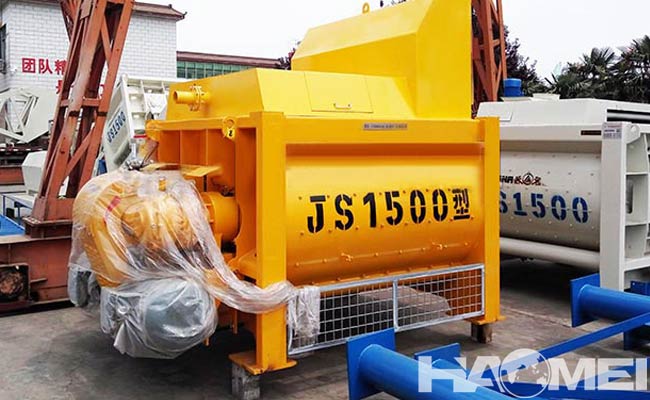
Now, I will conduct an in-depth comparison of the JS1000 and JS1500 concrete mixer from three dimensions: technical parameters, structural design, and application scenarios, to facilitate your accurate model selection.
1. Comparison of core parameters:
- Production capacity and energy consumption balance:
The theoretical production rate of the JS1000 concrete mixer is 50-60 m³/h, suitable for HZS50/60 concrete batching plants. The single-unit power configuration is a 37kW mixing motor + 11kW winch motor, with a unit capacity energy consumption ratio of 0.62 kW·h/m³. The JS1500 concrete mixer boasts an increased productivity of 75 m³/h, with the mixing motor power increased to 60 kW and the winch motor power to 18.5 kW, optimizing the energy consumption ratio to 0.78 kW·h/m³. Despite the increased absolute energy consumption per unit, the energy consumption per unit capacity only increased by 25.8%, demonstrating superior economic efficiency in large-scale projects.
- Aggregate processing capacity
Both models support 80mm gravel/60mm crushed stone aggregates, but the JS1500 concrete mixer achieves stronger material shearing force through a synergistic design of 2×10 sets of mixing blades (compared to 2×8 sets for the JS1000 concrete mixer) and a rotation speed of 25.5 r/min. Actual test data shows that when mixing dry-hard concrete (slump ≤30mm), the JS1500 reduces the mixing time by 12% compared to the JS1000 concrete mixer, and lowers the aggregate breakage rate by 0.8%.
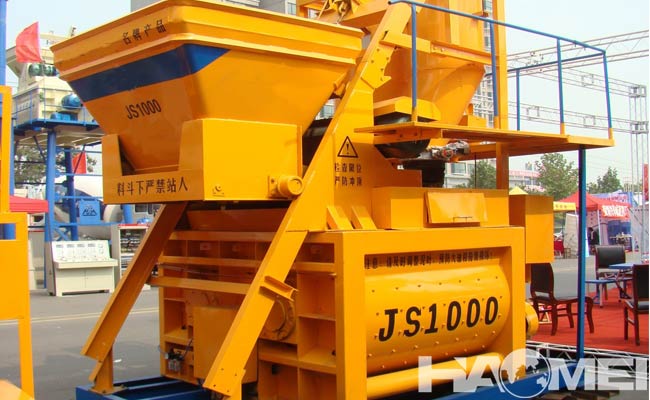
2. Structural innovation
- Optimized transmission system
The JS1000 concrete mixer uses a cycloidal pinwheel reducer, which is compact but has limited impact resistance. The JS1500 concrete mixer upgrades to a planetary reducer, increasing torque density by 40% through multi-stage gear meshing and extending gear life to over 20,000 hours. Field tests on a Middle Eastern project show that the JS1500 concrete mixer's reducer failure rate is 67% lower than the JS1000 concrete mixer under continuous high-intensity operation.
- Innovative unloading mechanism
The JS1500 concrete mixer comes standard with a hydraulically driven unloading gate, supporting rapid opening and closing in 0.5 seconds, improving efficiency by 3 times compared to the JS1000 concrete mixer's manual/pneumatic system. Its dual-cylinder synchronous control technology reduces the unloading residue rate to below 0.3%, significantly reducing concrete waste. Statistics from a high-speed rail project in Africa show that the JS1500 concrete mixer's material loss cost is $1.2/m³ lower than the JS1000 concrete mixer.
3. Application scenarios
- JS1000 concrete mixer:
With its lightweight design of 8700kg (JS1500 is 11130kg) and adjustable unloading height of 2.7/3.8m, the JS1000 concrete mixer performs exceptionally well in rural infrastructure and precast component factories. Data from a Southeast Asian project shows that its average daily output per machine reaches 450m³, with a comprehensive equipment utilization rate of 82% and maintenance costs accounting for only 0.8% of the output value.
- JS1500 concrete mixer:
In ultra-large-scale projects such as cross-sea bridges and nuclear power plants, the HZS180 concrete batching plant, composed of the JS1500 concrete mixer and PLD3200 batching machine, can achieve a continuous feeding capacity of 180m³/h. Its compact transport dimensions of 5058×2250×2440mm (compared to 4640×2250×2250mm for the JS1000), coupled with a modular design, reduce ocean freight costs by 15%, making it the preferred model for "Belt and Road" projects.
4. Technological trends
Both models have achieved fully automated control throughout the entire process. However, the JS1500 concrete mixer , equipped with an IoT module, can upload mixing parameters and energy consumption data to a cloud platform in real time, supporting remote fault diagnosis and production optimization. In terms of environmental performance, the JS1500 concrete mixer's sealed mixing chamber design reduces dust emission concentration to below 8mg/m³, a 40% improvement over the JS1000 concrete mixer, meeting EU CE certification standards.
The differentiated positioning of the JS1000 and JS1500 concrete mixer essentially represents a balance between efficiency and cost, versatility and specialization. For small and medium-sized projects with a daily demand of ≤500m³, the JS1000 concrete mixer has an advantage due to its lower total life cycle cost; while in ultra-large projects, the JS1500 concrete mixer, with its flexible production capacity and high level of intelligence, becomes a key piece of equipment for improving project ROI. When selecting export models, it is necessary to combine factors such as the scale of projects in the target market, environmental regulations, and operation and maintenance capabilities to construct a precise product portfolio strategy.


