
Double Horizontal Shaft Concrete Mixer
As production technicians at Haomei Machinery, drawing on years of experience in equipment R&D and engineering adaptation, we understand that double horizontal shaft concrete mixers, with their core advantage of forced mixing, have become essential equipment for commercial concrete plants and large-scale projects. The scientific selection of output models and the precise control of working principles directly determine construction efficiency and concrete quality. The following is a professional analysis from a technical perspective, providing practical reference for potential customers.
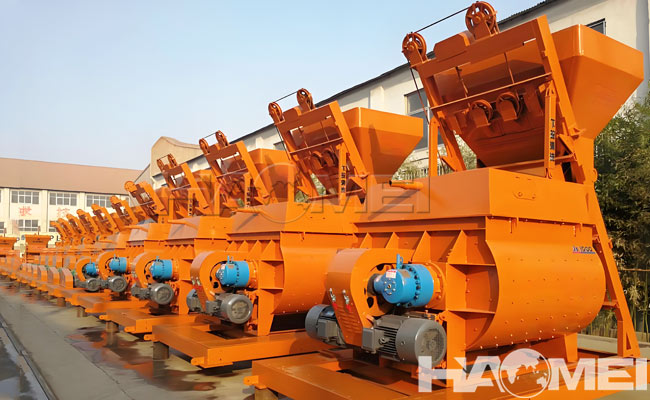
The output model system is the core basis for adapting equipment to engineering needs. Haomei Machinery adopts the industry-standard JS series double horizontal shaft concrete mixer, dividing it into six core models based on discharge capacity, covering all scenarios from small and medium-sized projects to large-scale mixing plants. Among them, the JS500 model (discharge capacity 500L) has a productivity of ≥25m³/h and a total weight of 4000kg. It is suitable for small-scale construction projects such as rural roads and small buildings. Its compact structure (transportation dimensions 3030×2300×2800mm) facilitates transportation in complex sites such as mountainous areas. The JS1000 model (discharge capacity 1000L) has a productivity of ≥50m³/h and a mixing blade speed of 25.5r/min. It can be matched with medium-sized commercial concrete plants and can also produce C30-C50 conventional grade concrete. The flagship model, the JS3000, has a discharge capacity of 3000L and a productivity of ≥150m³/h. It is equipped with a 110kW high-efficiency motor and can stably produce grade IV concrete for dams (maximum particle size 160mm). It is suitable for large-scale infrastructure projects such as high-speed railways and bridges. When selecting a model, it is crucial to match the aggregate size, concrete grade, and daily production requirements. For example, when producing self-compacting concrete (SCC), it is recommended to prioritize models JS750 and above to ensure homogeneity.
The core technology for its efficient homogenization lies in the three-dimensional forced mixing principle. The equipment utilizes double horizontal shafts rotating synchronously in opposite directions, driving spirally arranged mixing blades on the shafts to form a composite motion trajectory: while the blades propel the material in a circular motion, an axial pushing force is generated using an adjustable blade angle of 15°-22°. A strong vortex is formed in the intersection area of the double shafts, achieving the superposition of radial, axial, and circular three-dimensional motions of the material. This design ensures thorough material exchange, reducing mixing time by 15%-20% compared to traditional models, and achieving homogeneity fluctuations of ≤2%. In terms of key technology assurance, a dual sealing structure of "mechanical seal + lip seal" is adopted, coupled with a pressure compensation device, controlling the grout leakage rate to below 0.1%. The mixing blades use a tungsten carbide wear-resistant layer, increasing service life by more than 60%. The drive system uses a permanent magnet synchronous variable frequency motor, saving 80-120 kWh per day compared to a fixed frequency motor, reducing energy consumption by 6.9%. Notably, through "slow-fast-slow" mixed cycle control, the mixing quality of special concrete can be further improved, reducing binder loss by 3%-5%.
In summary, the core of selecting a double horizontal shaft concrete mixer is "matching output to demand and adapting the principle to the material." Haomei Machinery, through modular design, can customize the mixer, drive unit, and other configurations according to customer needs, ensuring that the equipment is adaptable to the raw material characteristics and engineering standards of different regions. Potential customers are advised to collaborate with the technical team to complete the selection process, considering actual production capacity requirements, concrete type, and site conditions, to maximize equipment cost-effectiveness and operational stability.


