
Advantages of SICOMA Twin-Shaft Concrete Mixers
SICOMA twin-shaft concrete mixers are widely used in commercial concrete batching plants, precast component factories, water conservancy projects, and high-speed railway construction. The flagship product line is the MAO series twin-shaft forced concrete mixers, which includes models such as the MAO 750/500, 1500/1000, 2250/1500, 3000/2000, and 4500/3000.
For users requiring stable production of C30–C60 commercial concrete, pumpable concrete, or precast concrete, the mixing unit is the critical factor determining discharge uniformity, production cycle times, and long-term maintenance costs. The Sicoma twin-shaft design is highly reliable for continuous, high-intensity production, making it a preferred choice for mid-to-high-end concrete batching plants.
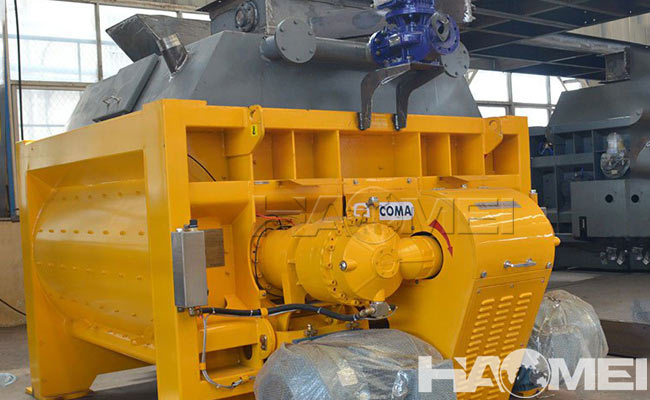
1. Twin-Shaft Forced-Action Mixing for Superior Uniformity
Sicoma mixers utilize two horizontal shafts that rotate in opposite directions. The mixing paddles drive the mortar, aggregates, and cement paste through a cross-circulation pattern within the mixing drum, preventing the aggregation of materials in any single area.
Taking the SICOMA MAO 3000/2000 model as an example—which features a discharge capacity of approximately 2m³ and is typically equipped with a drive system of 2×37kW (or similar power)—it is well-suited for integration into an HZS120 concrete batching plant, offering a theoretical production capacity of around 120m³/h.
In actual operation, the mixing cycle for standard C25–C40 concrete is typically 45–60 seconds. For high-strength concrete (C50 and above), mixes with low water-binder ratios, or formulations incorporating fly ash or ground granulated blast-furnace slag (GGBS), the mixing cycle is generally set between 75 and 120 seconds. Twin-shaft paddles break up cement clumps more rapidly, ensuring that the paste coats the aggregates uniformly.
2. Versatility for a Wide Range of Concrete Mix Designs
Construction projects utilize a diverse array of raw materials—such as river sand, manufactured sand, crushed stone, gravel, fly ash, mineral powder, chemical admixtures, and fibers—each placing unique demands on the concrete mixer.
Sicoma twin-shaft mixers are well-suited for the following materials and applications:
Aggregates with a maximum particle size of 40mm, 60mm, or other sizes as specified by the design requirements;
Concrete mixes containing manufactured sand with high fines content;
High-strength concrete (C40–C60);
Pumpable concrete and low-slump concrete;
Concrete for precast products, including pipe piles, box culverts, blocks, and structural components;
Roller-compacted concrete (RCC) and various types of specialty concrete.
In the production of precast elements, concrete often requires a low slump and precise aggregate gradation. Simply extending the mixing time is insufficient to resolve the issue of material clumping. Twin-shaft forced mixing provides superior shearing and folding action, which helps ensure consistent surface quality and early-stage strength in the finished components.
3. Wear-Resistant Liners and Paddles for Long-Term, Heavy-Duty Operation
The liners, mixing paddles, mixing arms, and discharge gates within the mixing chamber are subject to constant impact and friction from sand and stone. When aggregates are highly abrasive or manufactured sand features sharp, angular particles, the wear rate of these components increases significantly.
Sicoma twin-shaft concrete mixers typically utilize highly wear-resistant alloy liners and paddles, with adjustable paddle angles. Operators can make adjustments or replace specific worn parts as needed, rather than having to replace the entire set of components.
When Haomei Machinery configured an HZS90 concrete batching plant for a client in the Middle East—where hard crushed stone is used and daily production is scheduled to exceed 10 hours—we recommended SICOMA twin-shaft mixer equipped with reinforced, wear-resistant components. We also advised including paddles, liners, shaft-end seals, and discharge gate seals in the initial spare parts inventory, thereby minimizing the risk of equipment downtime while waiting for replacement parts.
4. Reliable Shaft-End Sealing to Reduce the Risk of Slurry Leakage
The shaft-end sealing of a twin-shaft concrete mixer is a critical focus for maintenance. If the seal fails, cement slurry can enter the bearing area; in the best-case scenario, this leads to increased lubricant consumption, while in the worst-case, it causes damage to the bearings and the gearbox.
SICOMA concrete mixers typically feature a multi-layered sealing system combined with an automatic lubrication design, which creates a protective seal zone using grease. For ready mix concrete batching plants with high production frequency, operators should inspect the grease supply, the condition of the seal cavity, and the area around the mixer’s discharge gate for any slurry leakage during every shift.
Field maintenance experience shows that shaft-end issues are frequently linked to "insufficient lubrication" or "untimely cleaning." It is recommended to include automatic lubrication system alarms in the daily pre-operation checklist and to monitor seal wear based on the total volume of concrete produced.
5. Rapid Discharge for Enhanced Efficiency
SICOMA twin-shaft mixers are generally equipped with wide-opening discharge gates. Once the mixing process is complete, the concrete can be rapidly discharged into concrete transit mixers, conveyor belts, concrete pump hoppers, or precast concrete distribution systems.
For medium-to-large-scale concrete batching plants—such as HZS90 or HZS120 models—the discharge time directly impacts the start of the next batching cycle. If the mixing process takes 60 seconds and the discharge takes 20–30 seconds—while being synchronized with the weighing of aggregates and powders—the concrete batching plant can achieve its full designed production capacity.
Haomei Machinery offers customizable options for discharge gate configurations, hydraulic power unit setups, and discharge heights to suit specific production requirements. When the concrete mixer needs to discharge into concrete transit mixers, the height of the concrete mixer truck’s feed opening must be verified in advance. For applications involving precast concrete distribution systems, the discharge outlet dimensions and the height of the steel support structure should be adjusted to align with the receiving hopper.
Before selecting a SICOMA concrete mixer, please confirm the following four parameters:
Target production capacity (e.g., an HZS60 concrete batching plant typically uses a 1m³ mixer, while an HZS120 concrete batching plant typically uses a 2m³ mixer);
Maximum aggregate particle size (commonly 20mm, 40mm, or 60mm);
Type of concrete (e.g., standard ready-mix, pumpable, high-strength, precast, or roller-compacted concrete);
Daily operating hours and the local availability of spare parts.
Haomei Machinery can equip HZS60, HZS90, HZS120, and HZS180 concrete batching plants with SICOMA twin-shaft mixers; we also offer alternative proposals featuring high-end, domestically manufactured twin-shaft mixers. Please provide your target capacity, concrete grade, aggregate size, and the destination country for your project. We will then supply a mixer selection recommendation, a list of wear parts, a packing plan, and a comprehensive quotation.


