
Twin Shaft Concrete Mixer Machine
As the core unit of a concrete mixing system, the performance differences of twin shaft concrete mixer machine do not stem from the common structural basis of "twin-shaft rotation," but rather from the refinement of their internal flow field design. For models with the same nominal volume, differences in blade arrangement, shaft diameter ratio, and linear velocity control can result in performance gaps of 30% to 50% in mixing homogeneity, energy consumption, and the lifespan of vulnerable parts. Currently, in the global market, JS general-purpose economic concrete mixers and SICOMA MAO industrial-grade concrete mixers are the two mainstream technical routes for twin-shaft concrete mixer machine. Haomei Machinery has completed the full-specification production capacity layout of both series.
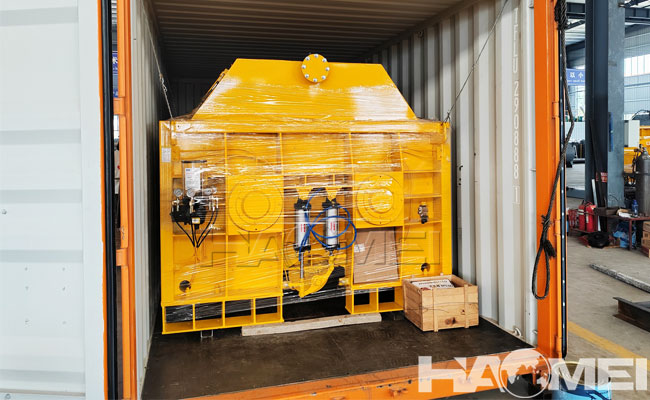
The efficiency of the mixing flow field construction is a core indicator for measuring the design level of the twin shaft concrete mixer machine. During the dual-shaft counter-rotation process, the material within the chamber forms three functional zones: a strong convection zone, a shearing zone, and an edge tumbling zone. The proportion of the strong convection zone directly determines the mixing efficiency and homogeneity. In industry-standard designs, the strong convection zone accounts for approximately 55%, requiring a mixing cycle of over 90 seconds to meet homogeneity requirements. Industrial-grade models optimized through fluid simulation can increase the strong convection zone proportion to over 70%, shortening the mixing cycle by 15% under the same operating conditions. The corresponding blade linear velocity parameters are typically set between 1.6 and 2.2 m/s: below 1.6 m/s, the mixing shear force is insufficient, leading to powder agglomeration in high-strength concrete; above 2.2 m/s, the wear rate between the blades and the liner doubles.
Within Haomei's product portfolio, two major twin shaft concrete mixer machine series employ differentiated flow field calibration strategies:
The JS series twin shaft concrete mixer machine utilizes an industry-standard flow field architecture, covering specifications from JS500 to JS4000. The strong convection zone accounts for approximately 55%, with a blade linear velocity set at 2.0 m/s and a standard mixing cycle of 90 seconds, effectively meeting the needs of conventional concrete production while balancing production efficiency and manufacturing costs.
The SICOMA MAO series twin shaft concrete mixer machine employs an optimized, multi-dimensional flow field design, covering all models from MAO1000 to MAO4000. The strong convection zone accounts for 72%, and the blade linear velocity is precisely controlled within the optimal range of 1.75~1.85 m/s. While ensuring the homogeneity of concrete with strengths up to C80 meets standards, it reduces the wear rate of vulnerable parts by more than 25%, making it suitable for high-load continuous production conditions.
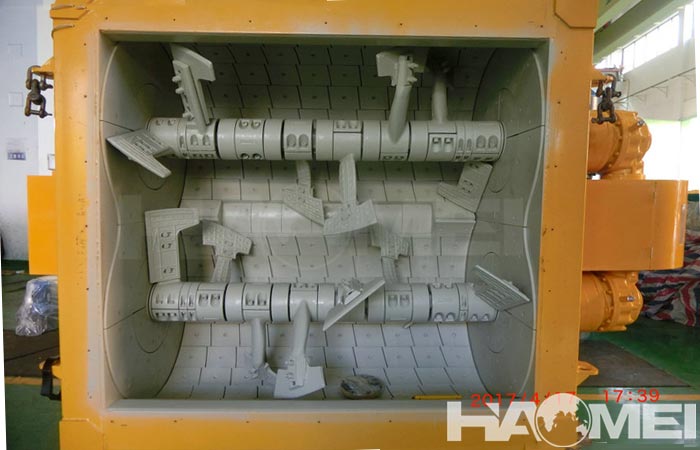
Subtle differences in core structural parameters can directly amplify the flow field performance. The ratio of the shaft spacing to the mixing diameter is a key design threshold. The industry-optimal design range is 0.72~0.78. At this ratio, the superposition efficiency of the biaxial flow fields is the highest, there is no dead zone in the middle of the cavity, and the radial tumbling intensity of the material reaches its peak. When the ratio is less than 0.7, the risk of interference between the two shaft blades increases, and a dead zone of material accumulation easily forms in the middle; when it is greater than 0.8, the flow field superposition effect is insufficient, the convection intensity decreases, and the overall mixing efficiency decreases by more than 10%. The blade tilt angle and arrangement are also crucial. An axial tilt angle of 35°~40° combined with staggered blades can achieve a three-dimensional mixing effect of axial circulation and radial tumbling of the material.
In the mass production designs of the two series, the SICOMA MAO series twin shaft concrete mixer machine strictly controls the pitch ratio at the optimal threshold of 0.74, paired with 16 staggered stirring blades and a 38° axial tilt angle. The gap between the liner arc surface and the blades is precisely controlled at 3~5mm, and with Ni-Hard 530HB high-hardness wear-resistant liners, it effectively eliminates the bottom material accumulation blind zone while ensuring component durability. The JS series twin shaft concrete mixer machine has a pitch ratio of 0.80 and adopts a layout of 12 equidistant straight blades. Its design orientation is more inclined towards structural simplification and manufacturing cost control. It has strong spare parts versatility, convenient replacement and maintenance, and is suitable for the lightweight operation and maintenance needs of small and medium-sized projects.
Based on the differences in flow field characteristics, the two series twin shaft concrete mixer machine form clear operating condition adaptation boundaries and also correspond to the needs of overseas markets in different regions.
For conventional applications such as C30 and below commercial concrete, municipal infrastructure, and short-term construction, the Haomei JS series twin shaft concrete mixer machine can fully cover production needs, offering lower equipment procurement costs and outstanding overall cost-effectiveness. They are the mainstream choice for small and medium-sized engineering plants and precast component factories in Africa and Southeast Asia.
For special applications such as C60 and above high-strength concrete, self-compacting concrete, and fiber-reinforced concrete, as well as large-scale commercial mixing plants with an annual capacity of over 300,000 cubic meters and 24-hour continuous production, the SICOMA MAO series twin shaft concrete mixer machine, with its optimized flow field design, is more adaptable. Its higher mixing homogeneity and lower total life-cycle maintenance costs fully meet the stringent requirements of high-end infrastructure and commercial concrete projects in the Middle East and Australia.
Overall, the selection of twin shaft concrete mixer machine should not be based solely on discharge volume and motor power. The diameter-to-spacing ratio, blade linear velocity, and blade placement method corresponding to the flow field design are the core indicators that determine performance boundaries. Haomei Machinery's JS series and SICOMA MAO series twin shaft concrete mixers correspond to the two major positioning of economy and industrial grade respectively, covering a full range of capacity from 0.5m³ to 4m³. Engineering parties can flexibly select the model according to the project conditions, production intensity and budget planning, and find the optimal balance between capacity, energy consumption and service life to maximize the benefits of the project throughout its entire life cycle.


