
Structure of JS Twin-Shaft Concrete Mixers
The JS series twin-shaft concrete mixer is the most widely used type of mixing unit in construction and commercial ready-mix concrete sectors. Its structural design has been proven through years of market application, offering the advantages of being a mature, universal solution with readily available spare parts and straightforward maintenance. The entire JS series twin shaft concrete mixers from Haomei Machinery utilizes a standardized, modular design. The machine can be broken down into five core systems—the mixing chamber, the main shaft mixing assembly, the transmission/power system, the discharge and sealing system, and the lubrication and electrical control system—which work in coordination to facilitate the continuous production of concrete.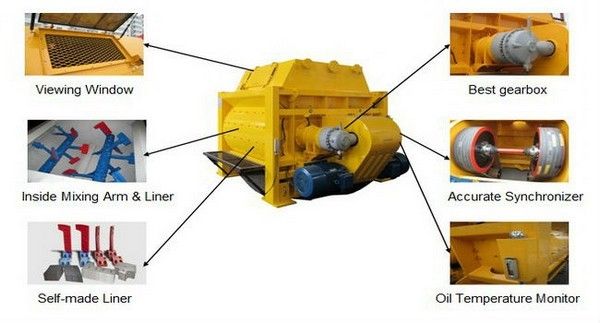
The mixing chamber serves as the structure foundation, directly determining the equipment's rigidity and service life. The chamber is constructed from thickened manganese steel plates, welded into a single unit. The steel plate thickness is 8mm for the JS1000 model, 12mm for the JS2000 model, and reaches 14–16mm for the JS3000 model and larger. A grid of intersecting longitudinal and transverse reinforcement ribs is added to the exterior to enhance overall resistance to deformation. The interior walls of the chamber are lined with high-chromium alloy wear-resistant plates (with a hardness of ≥400 HB), which are secured with bolts and can be replaced individually as they wear down. The top of the mixing chamber features dedicated inlet ports for aggregates, powders, water, and admixtures. An inspection/access door is provided on the side, equipped with a safety interlock switch in compliance with international safety standards. Drawing on extensive experience in exporting equipment, the reinforced chamber structure offers superior stability—even in overseas markets where sand and gravel often have high clay content—reducing the incidence of chamber cracking by more than 60% compared to thin-walled designs.
The main shaft mixing system serves as the core of the mixing operation, consisting of two parallel mixing shafts, mixing arms, and mixing blades. The shafts are forged from quenched and tempered alloy steel; the shaft diameter is 120 mm for the JS1000 model, 160 mm for the JS2000, and 180 mm for the JS3000, ensuring sufficient flexural strength for continuous, full-load operation. Each shaft is fitted with multiple mixing arms arranged in a staggered, helical pattern. The JS1000 features 7 blades per shaft, the JS2000 has 9, and the JS3000 is equipped with 10–12. The blades are cast from high-chromium alloy iron and installed at an axial angle of 35°–40°. As they rotate, they induce both radial convection and axial circulation of the materials, creating a three-dimensional mixing flow field. The shafts operate at a stable speed of 23–35 rpm, with a blade linear velocity maintained at 1.8–2.0 m/s—a balance optimized for both mixing efficiency and the wear rate of the components.
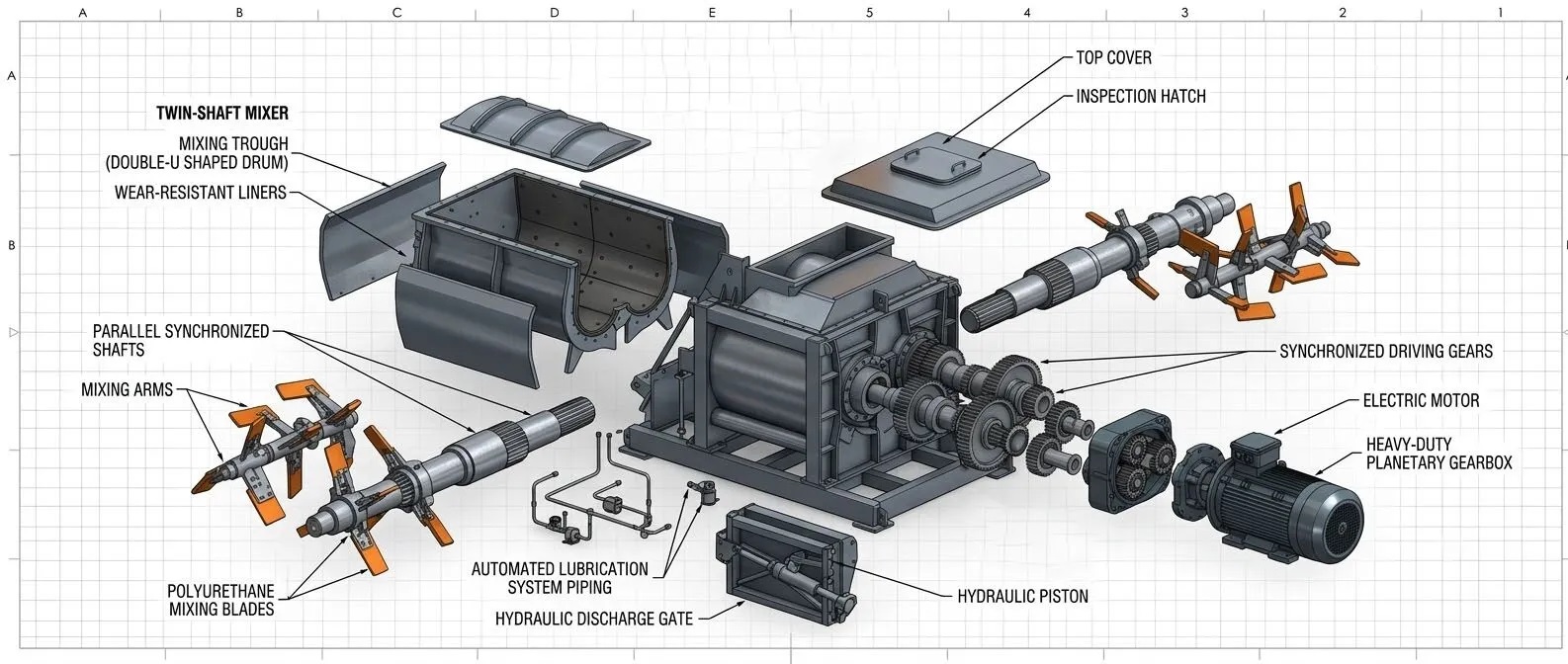
The drive system provides the necessary torque for the entire unit, typically utilizing a symmetrical configuration with dual motors and dual gear reducers. The power unit employs three-phase asynchronous motors: the JS1000 is equipped with two 18.5 kW motors, the JS2000 with two 30 kW motors, and the JS3000 with two 45 kW motors. Each motor is connected to a planetary gear reducer via a flexible coupling, which then drives the mixing shaft directly, achieving an overall transmission efficiency of approximately 88%. Synchronous dual-shaft operation is ensured through gear meshing, with both main shafts rotating in opposite directions at identical speeds—a design that prevents uneven material distribution and accumulation. This transmission architecture is a mature technology with highly interchangeable spare parts, which are readily available in most industrial markets worldwide; this makes it an especially suitable choice for projects in overseas regions where supply chains for replacement parts may be less developed.
The discharge and sealing systems ensure continuous production and operational reliability. The discharge mechanism utilizes a hydraulic cylinder to operate an arc-shaped discharge gate; for models JS2000 and larger, a dual-cylinder synchronous drive system is employed. The discharge gate can open up to 130°, allowing the 2m³ model to complete a full discharge in under 10 seconds, ensuring thorough emptying with no residual material. The shaft-end sealing system features a dual-layer design—combining a radial shaft seal (oil seal) with packing—complemented by periodic grease injection to create a protective barrier that prevents concrete slurry from infiltrating the bearing housings. The equipment is also equipped with a centralized lubrication system, which allows for manual or semi-automatic, metered grease application to all lubrication points, thereby reducing the burden of routine maintenance.
The electrical control system serves as the central hub for the entire machine, integrating functions such as mixing sequence control, overload protection, and safety interlocks, while also supporting integration with the supervisory control systems of a concrete batching plant.
The structural design of the JS series twin shaft concrete mixers prioritizes versatility and cost-effectiveness. Offering exceptional reliability and a high price-to-performance ratio under standard operating conditions, these mixers are the preferred choice for small-to-medium-sized commercial concrete plants and infrastructure projects.


